
Performance Marketing vs Traditional Marketing: What Works Best in 2026?
In today’s rapidly evolving business landscape, marketing strategies are no longer one-size-fits-all. With increasing competition and rising customer expectations, businesses must choose smarter ways to promote their products and services.
Two dominant approaches—traditional marketing and performance marketing—continue to shape the industry. But in 2026, which one truly delivers results?
Let’s break it down.
What is Traditional Marketing?
Traditional marketing refers to conventional advertising methods such as:
- Television commercials
- Radio ads
- Billboards
- Print media (newspapers & magazines)
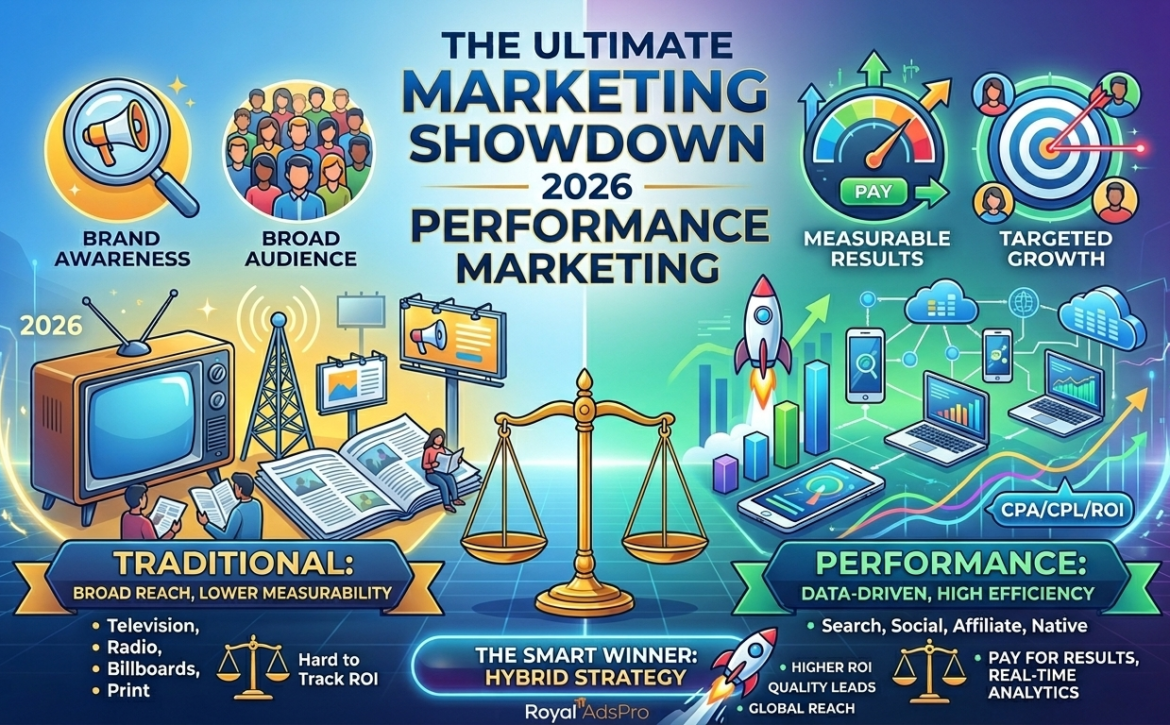
These methods focus on brand awareness rather than measurable outcomes. While they still hold value, especially for large-scale exposure, tracking ROI can be difficult.
What is Performance Marketing?
Performance marketing is a data-driven strategy where advertisers pay only when a specific action is completed, such as:
- Clicks
- Leads
- Sales
- Conversions
This includes channels like:
- Affiliate marketing
- Search engine marketing (SEM)
- Social media advertising
- Native advertising
Unlike traditional methods, performance marketing is fully measurable and scalable.
Key Differences Between Traditional & Performance Marketing
1. Measurability
- Traditional: Limited tracking
- Performance: Real-time analytics and insights
2. Cost Efficiency
- Traditional: High upfront costs
- Performance: Pay-for-results model
3. Targeting
- Traditional: Broad audience
- Performance: Highly targeted campaigns
4. Flexibility
- Traditional: Hard to adjust once launched
- Performance: Easily optimized anytime
Why Performance Marketing Dominates in 2026
🔹 1. Data-Driven Decisions
Modern businesses rely heavily on analytics. Performance marketing provides actionable insights that help improve campaigns continuously.
🔹 2. Better ROI
Since you only pay for results, your marketing budget is utilized more efficiently.
🔹 3. Scalable Growth
Campaigns can be scaled quickly based on performance metrics, making it ideal for startups and enterprises alike.
🔹 4. Global Reach with Precision
You can target specific demographics, locations, and behaviors—something traditional marketing struggles to achieve.
Is Traditional Marketing Still Relevant?
Yes—but with limitations.
Traditional marketing still works well for:
- Brand recognition
- Mass awareness campaigns
- Local offline promotions
However, it lacks the precision and adaptability required in today’s digital-first world.
The Smart Approach: Hybrid Marketing Strategy
The most successful businesses in 2026 don’t choose one—they combine both.
A hybrid strategy allows you to:
- Build brand trust (traditional)
- Drive conversions (performance marketing)
- Maximize overall ROI
How Royal AdsPro Helps You Win
At Royal AdsPro, we specialize in performance-driven marketing solutions designed to:
- Generate high-quality leads
- Increase conversion rates
- Deliver measurable growth
Our approach blends advanced analytics, affiliate networks, and targeted advertising to ensure your business stays ahead of the competition.
Final Thoughts
In 2026, performance marketing is no longer optional—it’s essential.
While traditional marketing still has its place, businesses that prioritize data, ROI, and scalability will dominate the market.
If you want faster growth, better leads, and measurable success, performance marketing is the clear winner.